

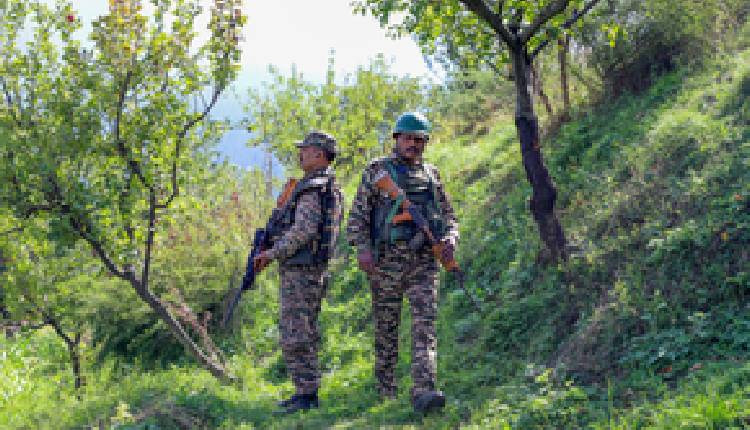
New Delhi: Dense forest cover in Kashmir has long been used by terrorists to evade security forces after carrying out attacks. The thick foliage and difficult terrain have made counter-operations extremely challenging for the security forces, often turning such missions into prolonged and complex exercises.
For years, infiltrators entering Jammu and Kashmir have taken refuge in forests, lying low until they receive instructions to strike. A similar pattern was observed in the Pahalgam attack in April last year, where terrorists reportedly used forest cover both before and after the incident.
In response, security forces launched Operation Mahadev to flush out those who were involved in the attack. An official said the operation demonstrated that terrorists can no longer rely on forests as safe havens.
Union Home Minister Amit Shah informed Parliament that the joint operation by the Army, the Central Reserve Police Force, and the Jammu and Kashmir Police on July 28 was successful. He said three terrorists, identified as Suleman, Hamza Afghani, and Zibran, were killed in an encounter under Operation Mahadev. The operation was conducted in the dense forest area of Lidwas near Harwan, on the outskirts of Srinagar.
An official involved in the planning said the terrorists were attempting to return to Pakistan. “The national security planners were clear that these elements were not getting out, and they had to be brought to justice,” the official noted.
A high-level meeting was held a day after the April 22 attack, bringing together officials from the Army, CRPF, and the Jammu and Kashmir Police.
“It was tough tracking the terrorists. We had credible information that they were still in the country. They were either planning to carry out another attack and were awaiting instructions or were trying to slip out. Whatever the case, the intention was to stop them from whatever further they were planning,” the official said.
“It was human intelligence that gave us the first tip. The terrorists were hiding in the Dachigam area. This led to extensive tracking and, with the help of technology, signals were captured. It was on July 22 that one of the terrorists’ signals was picked up. This led to the security forces launching the assault, during which the terrorists were surrounded and killed,” the official added.
Another officer said the terrain posed the greatest challenge.
“Our intelligence agencies were working seamlessly, and once the signals were caught, information began pouring in. However, the toughest part of the operation was the encounter itself,” the officer said.
He added that the area was marked by thick vegetation and high altitude, which constrained the movement of security personnel.
“The terrorists, on the other hand, were trying to exploit these tough conditions to evade arrest or elimination. In the end, the security forces got the better of them,” the officer said.
Officials described Operation Mahadev as a decisive effort that also sends a strong message to terror groups. For long, such groups have relied on dense forests and rugged terrain to evade capture, often managing to regroup and strike again.
Operation Mahadev, they said, underlines that such tactics will no longer guarantee safety.
“The security forces displayed exemplary skill and patience. Terror groups will think twice before using such cover and assuming they can get away with it,” an official said.
The operation reflects the resolve of security agencies to track down those involved in terror activities anywhere, even in the most inaccessible forest regions, said the officer.
(IANS)