RSS Outreach, Culture Can Coexist With Modernity: General Secretary Hosabale

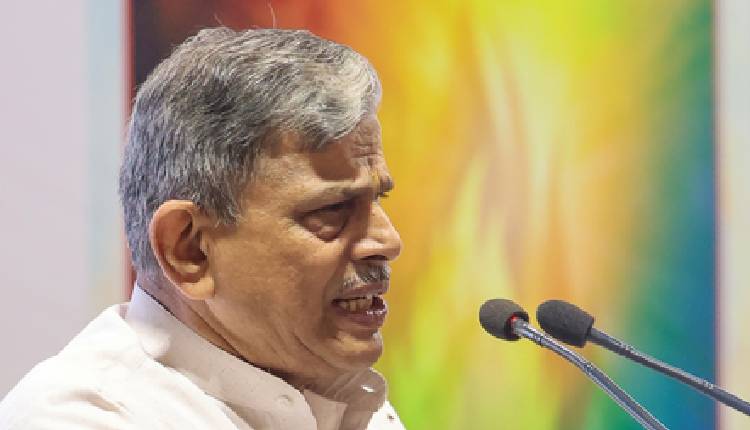
Washington: Rashtriya Swayamsevak Sangh (RSS) General Secretary Dattatreya Hosabale outlined the organisation’s global outreach, its civilisational worldview and its role in shaping social cohesion, arguing that cultural values and modernisation “can exist simultaneously” as India deepens engagement with the United States and other Western countries.
Speaking at a fireside chat at the Hudson Institute during the New India Conference, Hosabale described the RSS as a “people’s voluntary movement” rooted in “cultural ethos and civilisation values” of India, adding that its primary work over the past century has been to build a network of selfless volunteers committed to social service and nation building.
“RSS is the people’s voluntary movement, and inspired by cultural ethos and civilisation values… engaged for last 100 years to create volunteers,” he said, noting that the organisation conducts tens of thousands of daily and weekly gatherings to instil “self confidence, service mindedness and feeling of oneness.”
Hosabale said the RSS has expanded its work across sectors including education, health, rural development and disaster relief, with volunteers helping build “civic institutions numbering nearly 40… engaged in nation building activities.”
Addressing perceptions in the West, he said the organisation remains “extremely poorly understood,” adding that longstanding narratives portraying it as “anti minority, anti development, anti modernisation” are “not true” and have been shaped over decades.
On ideology, Hosabale emphasised that the RSS views Hindu identity as a civilisational concept rather than a religious one. “Hindu identity is a civilisational identity, not a religious one… there is no room for being alienated,” he said, adding that dialogue with different groups is essential to address “misconception” and “misgivings.”
He also rejected the notion that tradition and modernity are in conflict, arguing instead for a synthesis. “Cultural values and modernisation… are not contradictory… they can exist simultaneously,” he said, likening the relationship to a banyan tree with “deep, strong roots” and “new leaves and flowers” emerging over time.
On India’s global role, Hosabale said New Delhi seeks “good relations with all the countries,” including the United States, and stressed that partnerships must be built on “mutual trust… mutual respect and recognising the needs of each.”
He underscored the importance of people-to-people ties in strengthening the India-US relationship. “People to people relation should be strengthened… many a time prejudices work… better understanding is necessary,” he said, adding that institutions, think tanks and universities can play a key role in bridging gaps.
On domestic priorities, Hosabale outlined five focus areas for the RSS as it enters its next phase: “social harmony,” “eco friendly life,” “family values,” “self reliance,” and “civic duties and civic sense.” He said these principles are “universal” and aimed at building a “strong, prosperous nation” capable of contributing to global well-being.
He also described volunteerism within the RSS as a lifelong commitment rather than a transactional activity. “It is a way of life… 24 by seven and 365 days… once a swayamsevak, always a swayamsevak,” he said.
The fireside chat was part of the Hudson Institute’s New India Conference, which brought together policymakers, scholars and strategic experts to examine India’s growing global role and the future of the US-India partnership.
The conference comes at a time when Washington increasingly sees India as a key strategic partner in the Indo-Pacific, particularly amid rising competition with China and evolving geopolitical alignments.
The RSS, founded in 1925, is widely regarded as one of the largest volunteer organisations in the world and has historically influenced India’s socio-political landscape.
(IANS)