Govt Gave Full Freedom, Placed Full Trust In Army: Gen Naravane On India-China Standoff

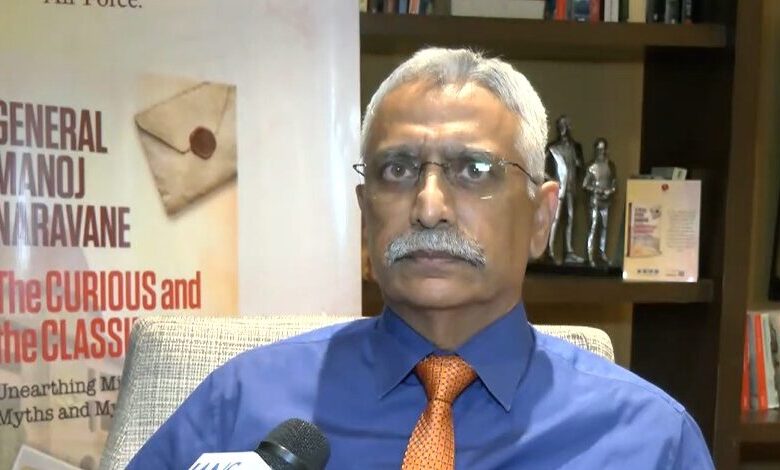
New Delhi: Former Indian Army Chief, General Manoj Mukund Naravane (Retd.) opened up about the recent controversy surrounding the India-China standoff of 2020, stating that the government has given “full freedom” to the armed forces to take actions in such situations, which shows that it has “full trust” in its military.
Gen M.M. Naravane, in an interview with IANS, in response to a question regarding Lok Sabha Leader of Opposition (LoP), Rahul Gandhi’s, claims about his unpublished memoir, ‘Four Stars of Destiny’, said, without naming anyone, that no copy of that book is in circulation, and he does not have any idea as to where the LoP got it from.
The former Army chief also spoke about his new book ‘The Curious and the Classified: Unearthing Military Myths and Mysteries’, the Indian Army’s different ‘War Cries’, including the famous “Badluram ka Badan”, the “apolitical” nature and stance of the armed forces, ‘Operation Sindoor’ and the lessons India can learn from the ongoing conflicts across the world.
The following are the full excerpts from the interview:
IANS: You have written another book, ‘The Curious and the Classified: Unearthing Military Myths and Mysteries’, which is non-fiction. There are many things that people are curious to know about the armed forces; things that are only known to soldiers and their families. Where did you get the idea to do so? There are many who are comparing it with Congress MP Shashi Tharoor’s ‘A Wonderland of Words’.
General Naravane: Thank you very much for speaking with me about my new book, ‘The Curious and the Classified: Unearthing Military Myths and Mysteries’. As you mentioned, Shashi Tharoor has a book called ‘A Wonderland of Words’, which contains about 100 or 101 essays, and each essay is a chapter. It discusses unique things about the English language. When I read that, I thought, why not write a book about the unknown aspects of the military? After that, I started looking into what ideas or chapters could be included.
I had some ideas in mind, but I wasn’t sure if it would reach the level of a full book or if it had enough substance. However, when I discussed a few of the ideas I had with my friends and fellow military personnel, surprisingly, even they didn’t know about them. So, I felt that if people who have been in the military and served in these areas don’t know about this, then the general public definitely wouldn’t know. They might just consider it classified information. So my intention with this book is to narrate such thrilling stories and anecdotes. There are 25 chapters, and each chapter is a story.
IANS: Since we have always seen that there is a mention of ‘War Cries’ in this book — the Assam Regiment’s “Badluram ka Badan” is also in it — and there are many such war cries. We know that when the Army goes to war or forward for any conflict, these things are said to raise morale. Which is your favourite?
General Naravane: I was commissioned into the Sikh Light Infantry, and I spent most of my service there. So, obviously, my favourite is “Chak De Phatte,” which is also a slogan of my regiment. It’s not a war cry — in battle, we say “Bole So Nihal, Sat Sri Akal” — but during sports or to encourage each other, we say “Chak De Phatte”. The phrase “Chak De Phatte” has even entered civilian life now. Whether to encourage someone at a party, or even the movie ‘Chak De! India’ featuring Shah Rukh Khan.
The general public uses it, but no one really knows where it came from. It originated during the era when battles were fought between the Sikhs and the Mughals. When the Sikh cavalry would attack the large Mughal camps, on their way back, they would lift the wooden planks (phatte) of the bridges. That’s why it became “Chak De Phatte.” They would tell each other, “Okay, the job is done, lift the planks, let’s go,” so that the Mughal Army couldn’t pursue them. So, this actually has its foundation in military history, which no one knows. So all the chapters in this book have some connection to military history.
IANS: This is your third book. There is one unpublished book, ‘Four Stars of Destiny’, which hasn’t been published yet but certainly sparked controversies. LoP Rahul Gandhi even took the unpublished book outside Parliament and tried to corner the government over it. The book he had in his hand, do you consider it authentic?
General Naravane: I would just say that I myself haven’t seen a final copy of that book as an author. So, I can’t say which book it was or where it came from. As Penguin has also very clearly stated, ‘no copy of that book is in circulation, either in print, hard copy, or soft copy’. So, as for where it came from, what can I say about that?
IANS: At that time, there was a lot of focus on one alleged line in a chapter of that book. It has also allegedly been mentioned that the Army was told to “do whatever you deem appropriate (Jo uchit lage, vo karo)”. Was the wrong meaning derived from this line?
General Naravane: The Army is always given full freedom when it comes to taking action. And the freedom given implies that the government has full trust in its Army. So this should be viewed from that perspective. If you always want to see the glass half empty, then there is no solution for that.
IANS: The Indian Army, and armed forces as a whole, is an apolitical institution; however, politics involving the Army does happen and has been happening. What is your take on this?
General Naravane: I don’t believe that the Army is being brought into politics, nor will we, as an organisation, come into it. The Indian Army and armed forces are totally apolitical in every direction. However, following the orders of the political leadership does not mean you have become political. There is a difference between these two things.
If I pass an order to my junior, it is his duty to follow my order. So, as an Army Chief, who is my senior? The Defence Minister. If the Defence Minister passes an order, the Army has to follow it. This doesn’t mean the Army has become political.
The Army is apolitical, but there is a chain of command, and giving respect to that chain of command is the right course of action.
Understand the difference — we are an apolitical Army, and we will remain apolitical. And the attempts being made to drag the military into politics are bad for the country. If we are to move forward, the Army must remain apolitical because you have seen what happens in our neighbouring countries and how far ahead of them we have progressed. And if we have been able to progress so far ahead compared to other neighbouring countries, it is because we are apolitical.
IANS: Many people drag the Army’s name into political discourse, like they did regarding the operation that happened in 2020, basically making an issue out of it. What is your opinion on this?
General Naravane: People can make an issue out of anything; that is their choice. But we have so much self-confidence among ourselves that no matter what anyone says, we are not going to get trapped or caught in that web. We have faith in ourselves. I always used to tell my soldiers to have faith in themselves. Believe in yourself. Believe that we are a very good Army, a good organisation, and whatever actions we take will be for the betterment of the country.
IANS: At the time when the Indian and Chinese armies were face-to-face in 2020, what did the government do for sorting out the whole issue? How did the Indian Army retaliate, because everyone saw that the Chinese had to go back? What is the current status in the area? Do we still believe that we are fully capable and deployed to respond?
General Naravane: Whenever any action happens, it is always a “whole of nation effort”. It’s never just one branch or organisation. In this, the political dispensation has a contribution, the diplomatic side has a contribution, and the military has a contribution. So, everyone moving forward together is a whole-of-nation effort. And because we took this action unitedly, we were able to be successful.
Even now, we believe that the actions we took are the reason the PLA (People’s Republic Army) had to go back. All the things coming on TV screens showing them dismantling their bunkers — such things had never happened before, that China stepped back. We forced them to step back. So if this isn’t a victory, then what is? And if people aren’t ready to accept this either, which they are seeing with their own eyes on TV, then what else can I say?
IANS: Operation Sindoor is about to complete one year. Ever since it was launched, Pakistan hasn’t dared to conduct any such act again. As a former Army Chief, how do you view this entire operation, and how much change have you seen in this one year regarding preparations?
General Naravane: I would say that the action taken in Operation Sindoor had a big difference compared to the type of operations conducted previously. The surgical strikes after Uri were on camps close to the LoC. The airstrikes after Pulwama in Balakot were also in PoK, again targeting small camps. But this time, we targeted their leadership and headquarters, where the real pain is felt. We were sparing them before, and they used to think that if 2-3 terrorists die on the border, what difference does it make? Now, it’s different.
This time, we consciously made the decision that we won’t just attack terrorist camps on the LoC or POK, but we will also target their leadership and headquarters that receive financial support. This was a big difference. And that’s why the Defence Minister said, “Ghar mei ghus ke maarenge, jaha par bhi ho, koi bachega nahi (We will enter their homes and strike, wherever they may be, no one will be spared)”. I think they have learned a very big lesson that if you take such actions, you will have to pay a heavy price for it.
IANS: Every nation learns from war. We saw that during the Russia-Ukraine war, a lot of information came about the drones and other equipment. Currently, the ongoing West Asia conflict, which has impacted energy supplies, what lessons do we get and what areas need more work?
General Naravane: Every war provides many lessons. Some are immediate lessons from the battlefield, but it is difficult to determine how true they are or how much propaganda is involved. But when wars end, we can extract the real lessons.
However, based on what is happening right now, one thing is very clear: We urgently need to become Atmanirbhar (self-reliant). And self-reliance in all aspects, not just in military weapons. We must be self-reliant in food, medicine, energy, rare earth minerals, and everyday equipment. Because when such events happen, no one comes to your aid; everyone thinks of themselves. Therefore, thinking ahead, increasing this capability within our country is crucial.
IANS: The US-Iran negotiations are being held in Islamabad. Do you think Pakistan is always looking to take advantage of disaster opportunities?
General Naravane: At any given time, players keep changing. They are certainly taking advantage of this, and this isn’t the first time Pakistan has taken advantage of global tensions. When the Global War on Terror happened, Pakistan brought itself into the middle and ‘supported’ America. Even before that, when Russia invaded Afghanistan, Pakistan became a frontline state and again supported America. So this is nothing new. But if you look at its long-term effect, it has remained negative for them. So let’s see what happens moving forward.
(IANS)