
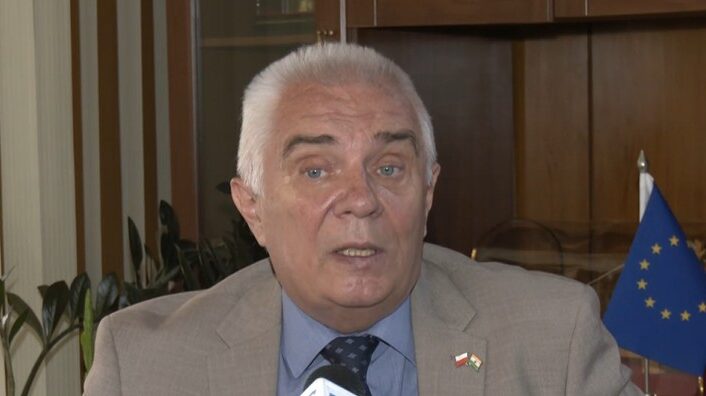
New Delhi: Polish Ambassador to India, Piotr Antoni Switalski, stated recently that Poland is a “staunch advocate” of enhancing the relationship between the European Union and India across various sectors, including Defence, in light of the recent Free Trade Agreement (FTA).
In an interview with IANS, Switalski expressed satisfaction with the interest of Polish companies in selling, manufacturing, and investing in India. He also noted that several Indian Defence companies have indicated their interest in investing in the European nation.
The Polish envoy also appreciated India’s efforts towards reaching a peaceful solution in the ongoing conflicts — West Asia and Russia-Ukraine wars — and stated that Poland is also looking forward to stabilisation of the situation.
The following are the full excerpts of the interview:
IANS: How is the Indian-Polish relationship shaping in recent times?
Switalski: Poland and India are now pursuing a strategic partnership. The visit of Prime Minister Modi to Poland in 2024 opened a new page. Now, we are trying to consolidate this new momentum in our relationship.
A positive context is the conclusion of the Free Trade Agreement between the European Union and India, which sends a reinforcing signal to our relationship. Poland is a staunch advocate of strengthening and deepening ties between the European Union and India. We believe our bilateral relations are a very precious addendum to the overall picture of a new strategic relationship between the European Union and India.
IANS: India has ordered Polish-made attack drones. What is the status of the order and delivery?
Switalski: The Defence sector is one of the sectors where I believe the prospects for our cooperation are quite good. India is seen as a very advanced and effective military power with advanced technology and extensive experience. Poland, too, is now beefing up its defences. As you know, Poland is spending almost 5 per cent of its GDP on Defence for obvious reasons. I believe our Defence sectors are in a good position to open new avenues and use the possibilities for cooperation.
You mentioned one aspect of it, but there are other possibilities. I’m very glad that Polish companies are interested not only in selling their products to India but also in investing in India, building manufacturing facilities, and exporting products to third markets. That’s a very good sign. India is seen as a partner, not just as a market.
Again, as a representative of Poland, I’ve received signals from very important Indian companies that want to invest in Poland in the Defence sector. As you can see, we have new opportunities now, and I hope we capitalise on them. Quite soon, we will be witnesses to the signing of new contracts and the inauguration of new production facilities.
IANS: What is the impact of the India-EU trade deal on Polish investment in India?
Switalski: I’m very glad the agreement on free trade was concluded. Poland has always been very supportive, and we believe it’s an important lever and tool we should use to boost our economic relationship. We should see the Free Trade Agreement as the floor, not the ceiling. It should be implemented well. We hope bilateral contacts and relations between EU member states (including Poland) and India will get an important boost.
I hope the FTA will come into force before the end of the year; at least that’s the plan in Brussels. I hope it could enter into force even sooner, but the end of the year is okay. It should be complemented by additional measures, including those relating to investment protection.
I’m not satisfied with the current level of India-Poland economic exchanges. The $6-billion annual trade volume is far from our capacity and our expectations. It is true that for several years, India and Poland were not active with each other. Now, it’s time we rediscover the new India, and India should look at Poland from a new perspective: Poland as the 20th largest economy in the world, a $1 trillion economy, and as one of the five key members of the European Union. The possibilities are here; let’s use them and send the necessary political signals, including from the top. I believe that quite soon, we can see results for the benefit of India and for our benefit.
IANS: What is your take on the ongoing conflict in West Asia?
Switalski: The war in West Asia complicated our supply chains and resulted in price hikes for oil, gas, and other mineral resources. It threatened many thousands of tourists, including Polish tourists. It is a disturbing factor. The situation is developing, so it’s difficult for me to comment on the current state.
Poland is in favour of the stabilisation of the situation, finding a peaceful solution to the conflict, restoring stability, and establishing an uninterrupted regime of navigation, which I think is very important.
We appreciate India’s effort in this direction. We are aware of your numerous contacts — your leaders, your Prime Minister, and your Foreign Minister — who are in close contact with the regional powers, the United States, and Israel. We are looking forward to the stabilisation of the situation.
We should reach a stage where we have an agreement and a peace deal, which should be implemented as soon as possible. We are not a direct player; we can only appeal, and that’s what we are saying to our allies, our friends, and our partners in the region.
IANS: What is your view on PM Modi’s effort to de-escalate the situation in West Asia? He regularly talks to all stakeholders, including Gulf countries.
Switalski: We appreciate the efforts of Prime Minister Modi. He is pursuing the understandable interests of India, because several of your ships were locked in the Persian Gulf and millions of your people still live in the Gulf states, and it is affecting your economy. We believe Prime Minister Modi is expressing the interests and expectations of other countries as well. He is acting for the sake of a peaceful solution to the conflict. India’s efforts are contributing to the peaceful resolution of this conflict.
We hope that common sense will prevail on the Iranian side and they will take the offer.
IANS: Do you think that this war is only dependent on oil or to establish a powerful influence in the Gulf?
Switalski: I believe that, as stated by President Trump, the main issue is the nuclear program of Iran. To what extent Iran is still willing to resume its nuclear program is another story. But Poland belongs to the countries that do not want to see a nuclear Iran. We support efforts to prevent Iran from developing nuclear weapons. That’s our traditional approach because we believe nuclear weapons in that region will have a very big destabilising effect.
We supported the efforts of the European Union and the United States to seek a deal with Iran. Regrettably, the perception was that this deal was not implemented in good faith by Iran, but that is subject to different assessments. We hoped that it could be solved without resorting to force. But we are where we are. We have the situation as it developed, and now we have to deal with the follow-up. The primary goal is not oil or regime change, as speculated by some observers; I believe the primary issue at stake is the nuclear program.
IANS: Does Poland back US President Trump’s claim for the Nobel Peace Prize? Do you think that he deserves it?
Switalski: The Nobel Peace Prize is decided by a narrow circle of people from the Norwegian Parliament. We do not participate in it. Different actors can submit candidates, and we understand that some politicians submitted the candidacy of President Trump. We will not comment on it, just as we didn’t comment on previous Nobel Prize winners. We hope that the Nobel Prize Committee will live up to the good practices and standards reflected in previous decisions.
I don’t think President Trump himself thinks much about the Nobel Prize; he made it clear during one of his recent statements that it’s not on his mind right now.
IANS: A few days ago, US President Trump criticised the Pope on social media, saying that he should stop supporting the radical Left. What is your take on this?
Switalski: We are for the separation of religion, the Church, and the state. We don’t want to be part of this discussion. We understand that the Pope reacted to the words of President Trump, but we are not the Church. We understand the role of the Catholic Church is to support peace and be against wars. But the head of the Catholic Church is not a politician.
You can remember the statements of the previous Pope on the war in Ukraine. Sometimes we didn’t like the statements, but we respect the role of the Pope and the Church, even if we disagree sometimes with his political assessments of what happened in Ukraine. As I said, we will not participate in this discussion.
IANS: Is there a possibility of a visit by any Polish leader to India?
Switalski: India is an important partner for us, and I hope very much that the contacts at the top level will get a new momentum. Prime Minister Modi visited Poland, opening a new chapter, and I believe very much that a visit by the Polish Prime Minister will send the right signals. Of course, it is subject to mutual agreement, but we are looking forward to such a visit in the not-too-distant future.
IANS: Poland continues to support Ukraine in its war against Russia. How is it affecting your nation?
Switalski: We support Ukraine. They are defending their statehood and territorial integrity. This war, this aggression by Russia against Ukraine, is affecting our security. For good reason, we are now increasing our Defence spending because we felt the impact of the war. As you know, even some Polish civilians were killed by a missile, and there were acts of terrorism on Polish territory, bombs planted on railways, attempts to set fire to storage facilities, and explosives planted on parcels to be transported by cargo planes.
We are too close to the battlefield to be neutral. We believe our security is threatened. Ukraine is not only defending itself. Of course, we are helping to the extent possible.
Like India, we would like this conflict to end as soon as possible because we are also paying the price. Poland has received more than 2 million Ukrainian refugees. There are still a large number of them in Poland — more than 1 million — mainly women with children. It puts a burden on our economy and our services: Schools, healthcare facilities, and so on. So yes, we are in favour of a peaceful deal based on just principles, not just any deal, but a just and lasting peace that will not reward the aggressor. That’s the basic point. We share the Indian approach: Let’s have a deal as soon as possible to end this war.
IANS: The European Union agreed to provide Ukraine with a large loan package. How do you see it?
Switalski: We supported it from the very outset. We believe it is necessary for sustaining the defence effort, the functioning of the economy and the state of Ukraine. As you know, this loan was blocked by Hungary. But a new government will be taking responsibility in Budapest, and because of that, all the vetoes previously put forward by Hungary are no longer valid. We have the loan. We hope that this loan will be harnessed to strengthen Ukraine’s economy and defence effort.
Poland also believes Ukraine should move forward on the track of membership in the European Union. It was blocked by Hungary again; however, we hope that the new government in Budapest will be constructive, and we will start real negotiations with Ukraine concerning membership in the European Union.
(IANS)