
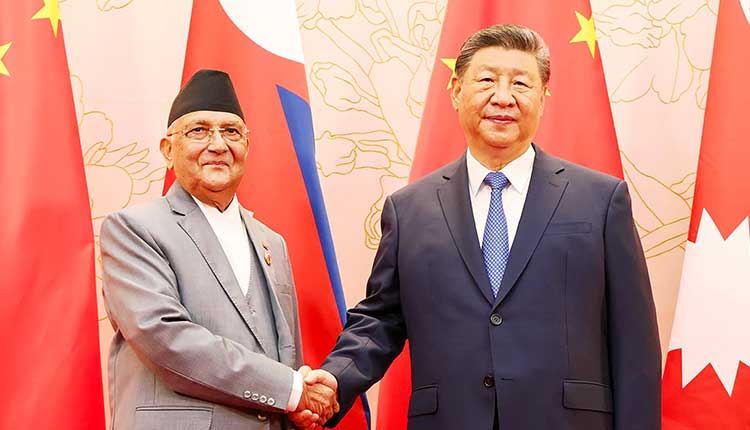
Kathmandu: China has used its economic ties with Nepal as a stepping stone for political interference in the Himalayan country, and several deals signed with the Asian giant are now being looked into with the new government taking over in Kathmandu.
“In recent years, China’s growing role in Nepal has moved beyond economic cooperation into areas that increasingly resemble strategic and political interference. From diplomatic pressure on issues related to Tibet and Taiwan to attempts at influencing internal decision-making, Beijing’s footprint in Kathmandu has expanded significantly,” according to an article published by the Institute for Conflict Research and Resolution (ICRR), a Delhi-based think tank.
It points out that during the tenure of K. P. Sharma Oli, Nepal signed several agreements with China, which were projected as transformative steps toward economic independence.
However, these deals are now being scrutinised by the country’s new government to investigate why several China-linked projects initiated during the Oli era were stalled, delayed or effectively stopped without clear reasons.
The new government has also announced that no new agreements with China will be considered until a full review of these projects is completed.
The turning point in Nepal-China relations came between 2016 and 2018, when Nepal moved closer to Beijing under the Belt and Road Initiative. The Oli government projected these agreements as a historic opportunity to transform Nepal into a regional connectivity hub. However, these infrastructure projects were not always backed by realistic planning or financial clarity, which sowed the seeds for future delays and complications.
In the list of stalled projects, the article lists the Budhi Gandaki Hydropower Project, awarded to China Gezhouba Group in May 2017, which was cancelled in November 2017, reinstated in 2018 and has remained effectively frozen since 2022 with no meaningful progress.
The proposed Kerung-Kathmandu railway, announced around 2016-2017, remains at the feasibility stage even in 2026, reflecting both technical challenges and a lack of financial closure.
Similarly, the Trans-Himalayan Multi-Dimensional Connectivity Network, launched under BRI between 2017 and 2018, has not moved beyond conceptual discussions. Cross-border transmission line projects discussed between 2018 and 2020 remain unexecuted.
Similarly, infrastructure at the Rasuwagadhi-Kerung border pushed between 2017 and 2020 has seen only partial and slow development. Northern highway connectivity projects initiated between 2016 and 2018 remain incomplete, while the majority of BRI-linked initiatives identified during 2018-2019 have not been implemented even by 2026.
Digital expansion efforts involving Huawei and ZTE since 2017 have also progressed unevenly, raising concerns over both execution and strategic implications, the article points out.
(IANS)