
New Delhi: While most exit polls have predicted a majority for the Bharatiya Janata Party (BJP) in this month’s West Bengal Assembly election, critics have pointed to their having largely failed in anticipating the 2021 outcome; but considering the massive turnout, the last regime change in the state, too, had followed a spike in voters’ participation.
If the pollsters are true this time, then West Bengal would witness a third regime change in half-a-century — since the major political upheaval across the country that followed the days of Emergency in India.
The 1977 change took place with just 56.15 per cent valid voters turning up to exercise their franchise, where men outnumbered women with 59.72 per cent to 51.86 per cent.
The Left Front assumed office, with Jyoti Basu as the Chief Minister, who would go on to rule for more than 23 tumultuous years.
His successor, Buddhadeb Bhattacharjee, led the Communists to victory in the 2006 Assembly election with better numbers, despite being termed underdogs against the ascending popularity of Mamata Banerjee.
As the perception firmed through the run-up to the Assembly election, a more than six per cent spike in voters’ turnout against the previous state poll was seen as a mandate favouring anti-incumbency.
However, the number was not the highest in the state’s Assembly poll history with the 1996 state election having witnessed 82.94 per cent electors’ participation.
In 2006, a massive on-ground mobilisation of cadres and an ardent appeal by Jyoti Basu were seen among reasons leading to the Left consolidating itself in the state Assembly.
The Left’s strong hold in rural Bengal, coupled with Mamata Banerjee’s alliance with the BJP — then seen by the sundry bhadralok as “communal” — were also perceived to have added to her having lost the game.
The Trinamool managed to win 30 out of a total of 294 seats, with its candidates even forfeiting deposits in around 58 Assembly constituencies. The BJP scored nil.
Mamata Banerjee, being the astute politician, soon began distancing herself from the BJP-led National Democratic Alliance (NDA), and picked the cudgel up against the state’s acquisition of farmland for industrialisation in Singur and Nandigram.
She gambled on the emotions of Bengal that was largely attached to land and which lived largely on farm produce.
Meanwhile, many in the Left, too, quietly distanced themselves from Buddhadeb Bhattacharjee’s slogan of “Agriculture is our foundation, industry the future”.
The subsequent 2011 Assembly poll saw a record turnout of 84.72 per cent voters, with women coming out in largest numbers ever, reaching 84.45 per cent to men’s 84.22, which was closer to their those-time average.
The Trinamool went on to corner 184 seats, with its new-found ally, the Congress, bagging 42 seats.
The alliance proved beneficial to both, with the latter adding 21 extra seats to its 2006 kitty.
As the Left bastion crumbled through the coming polls, finally achieving zero seats in 2021, the Trinamool continued to gradually increase its tally.
It broke out of the Congress alliance to further extend the footprint.
Mamata Banerjee led the Trinamool Congress to a 215-seat win in 2021, even as the turnout fell marginally to 82.30 per cent, while women recorded 81.75 to men’s 81.37 in poll participation.
The BJP evolved as the state’s principal opposition party with 77 seats, with the Left and the Congress wiped out completely from the Assembly.
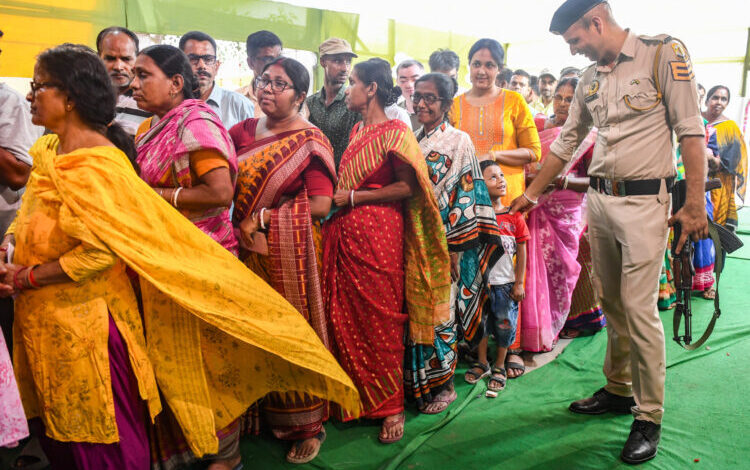
This year’s turnout has now broken all previous records with a 92.47 per cent participation; and both men and women coming out in the highest proportion ever, at 91.74 and 93.24 per cent, respectively.
While most pollsters predict the numbers having marked another government change in West Bengal, the voice of this huge people’s referendum would echo only on May 4.
(IANS)