
New Delhi: The Narendra Modi government has set a target of making India free from narcotics by 2047.
Speaking at the annual R N Kao Memorial Lecture organised by the Research and Analysis Wing, Union Home Minister Amit Shah reiterated the government’s commitment to achieving a Drug-Free India by 2047.
Security and anti-narcotics agencies say several international and domestic cartels are attempting to push drugs into India. In Jammu and Kashmir, Punjab and Maharashtra, enforcement agencies have intensified operations to curb the growing menace.
An official said that the road ahead is going to be tough with these cartels chasing newer states to further the drug trade. The modus operandi being used by the cartels in Punjab and Jammu and Kashmir is established patterns and conventional methods. In most cases, the agencies have managed to get the better of cartels.
However, the main concern for the agencies is now Kerala. Almost all cartels that target the Indian market are focusing heavily on Kerala. An official said the smuggling patterns in Kerala differ from those seen in other states, with traffickers constantly changing their methods. Agencies have found that almost every major drug seizure in the state reveals a new modus operandi, making enforcement operations more challenging and keeping investigators on constant alert.
In Kerala, the drugs earlier would make their way in from Afghanistan, Pakistan and into India. Once the contraband made it into Indian territory, the narcotics would be taken to Kerala by road. Officials now say the trafficking network has undergone a major shift, with most drugs, particularly heroin, increasingly being sourced and smuggled in through Myanmar.
Officials say heightened security along the India-Pakistan border in Jammu and Kashmir, Punjab and Rajasthan has made it increasingly difficult for narcotics cartels to use the traditional trafficking routes. As a result, smuggling networks have gradually shifted their operations, with a growing volume of drugs now entering India through Myanmar.
The Pakistani cartels have been coordinating with their counterparts in Myanmar. These persons push the heroin into India through the Bangladesh border, following which it makes its way to Kerala by road, an official said.
Another official said that, in addition to MDMA, the drug that is smuggled in large quantities into Kerala is heroin. “This is not only because of the demand, but the profit margins are very high. A kilogram of heroin is valued at anything between Rs 25-30 lakh. The dealers purchase each gram at Rs 3,000 and then sell it in the market at Rs 12,000 a gram,” the official said.
These profit margins are huge, and hence, heroin is the preferred drug that makes its way into the Kerala market.
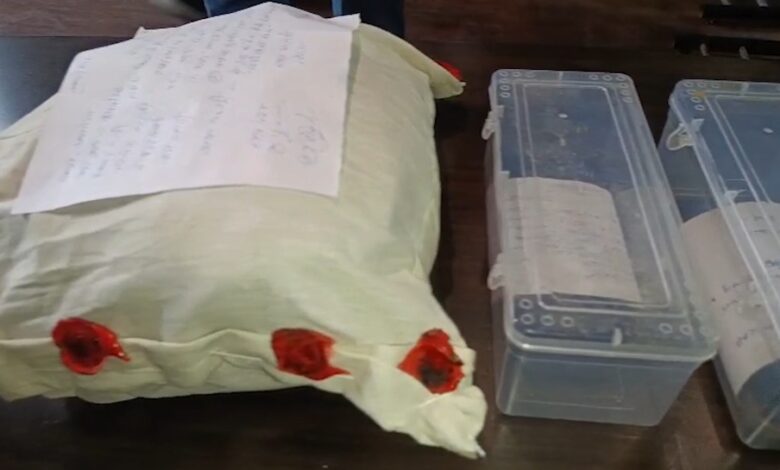
Further, these smugglers have found various methods to conceal the drugs. Heroin is concealed in soap boxes or in tiny bottles and smuggled into Kerala. The idea is to smuggle more, but in very small quantities per trip, another official said. This means those smuggling the drug from West Bengal or Assam come at regular frequencies. The fact that it is being smuggled in very small quantities and concealed in tiny bottles has only made the challenge for law enforcement agencies even harder.
“There are hits no doubt, but the misses are quite large owing to this modus operandi,” officials said.
This modus operandi came to light following the arrest of three from Assam in Angamaly, near Kochi, in Kerala. They were caught with 600 grams of heroin, which was hidden in over 40 soap boxes.
An official from the Intelligence Bureau said law enforcement agencies are closely monitoring the Malabar corridor in view of the sharp rise in drug-related activities. He said traffickers are increasingly targeting this region of Kerala for smuggling operations, with Kozhikode emerging as a major area of concern. The official added that large quantities of MDMA have been seized in the region, as demand for the synthetic drug has now overtaken that of marijuana.
Officials say the region has also become a preferred destination for traffickers because of its proximity to the Bengaluru-Mysuru corridor, which functions as a major transit hub. Kozhikode is additionally linked to several interstate road networks connecting Tamil Nadu, Karnataka and Andhra Pradesh, making the movement of contraband easier.
Investigators have also noticed a changing pattern in the choice of carriers. Officials say smuggling networks are increasingly using influential or high-profile individuals to transport narcotics. There has also been a growing preference for women carriers, as traffickers believe they attract less scrutiny during checks and surveillance operations.
Last month, the excise officials intercepted a car at Kerala’s Pantheerankavu toll plaza and seized 3.5 kilograms of MDMA worth Rs 3 crore. Two people, Fathima Nasreen, a 20-year-old social media influencer, and a repeat offender, P.K. Shafeeq, were arrested. They had reportedly sourced the drugs from Rajasthan and then driven all the way to Kerala.
In another incident, the agencies apprehended one Sheetal Shivdas (21) along with Firoz Musa. The agencies recovered 11.83 Kg of MDMA and 5.44 grams of cannabis from an apartment in Ulliyeri near the Malabar Medical College in Kozhikode.
Last year, one Yasar Arfath and Rincy Mumtaz, a YouTuber, were nabbed in Kochi along with 22 grams of MDMA. An official said that the changing patterns are making the battle against drugs harder in Kerala. The official said the smugglers’ tactics resemble methods once employed by Inter-Services Intelligence to expand espionage networks in India, with traffickers increasingly using women and social media influencers to widen their operations and move drugs discreetly.
(IANS)