
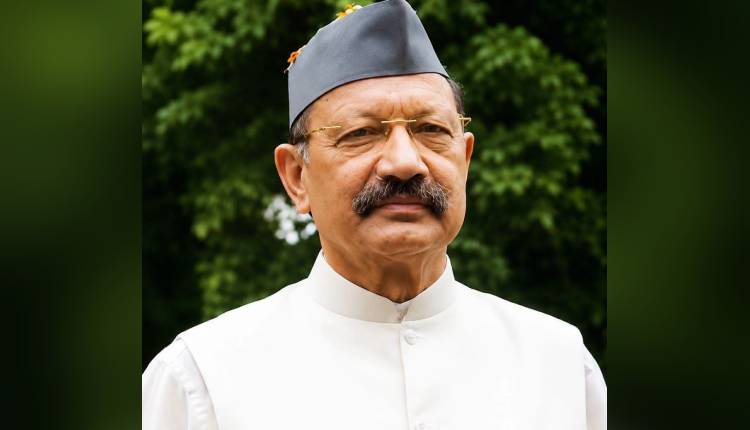
Dehradun: Former Uttarakhand Chief Minister Bhuwan Chandra Khanduri passed away at a private hospital in Dehradun on Tuesday at the age of 91 after a prolonged illness, triggering a wave of grief across the state and among political leaders from different parties.
Maj Gen Khanduri breathed his last at Max Hospital in Dehradun, where he had been undergoing treatment for age-related health complications. His demise has been widely mourned not only as the passing of a senior political leader but also as the loss of a disciplined and principled public figure whose identity remained deeply rooted in his military background.
Born on October 1, 1934, in Dehradun, Khanduri pursued his education at the University of Allahabad, the College of Military Engineering in Pune, the Institution of Engineers in Delhi, and the Institute of Defence Management in Secunderabad.
During his student years, he was influenced by the atmosphere surrounding India’s freedom movement and actively associated himself with the independence struggle.
From 1954 to 1990, he served in the Corps of Engineers of the Indian Army for nearly 36 years. During his distinguished military career, he held several important assignments, including serving as a Regimental Commander, participating in the 1971 India-Pakistan War, working as Chief Engineer in the Army, and later serving as Additional Military Secretary at Army Headquarters.
In recognition of his distinguished service to the nation, he was awarded the Ati Vishisht Seva Medal (AVSM) in 1982 by the President of India. The discipline, simplicity, and integrity that defined his military life later became the hallmark of his political journey as well.
Khanduri entered active politics during the Ram Mandir movement in the 1990s, when he joined the Bharatiya Janata Party. Though politics was an entirely new arena for the retired Major General, he approached it with the same determination and preparedness that had characterised his years in the Army.
In 1991, he was elected to the Lok Sabha for the first time from the Garhwal constituency. He continued to enjoy strong public support in the region and went on to win the same seat again in 1998, 1999, and 2004, representing Garhwal in Parliament on four occasions.
During the tenure of former Prime Minister Atal Bihari Vajpayee, Maj Gen Khanduri served as Minister of State (Independent Charge) for the Ministry of Road Transport and Highways between 2000 and 2003. In 2003, he was elevated to the rank of Cabinet Minister.
His tenure at the ministry coincided with a transformative phase in India’s infrastructure development. Maj Gen Khanduri played a major role in implementing the BJP-led government’s ambitious National Highway Development Project.
The landmark Golden Quadrilateral project, aimed at connecting the country’s four major metropolitan cities through a modern highway network, progressed significantly under his leadership. His administrative efficiency and disciplined approach were widely credited for accelerating the expansion of India’s highway infrastructure.
Following the 2004 Lok Sabha elections, Maj Gen Khanduri shifted his focus from national politics to Uttarakhand’s state politics.
In the 2007 Uttarakhand Assembly elections, he led the BJP to victory and took oath as the Chief Minister of the state on March 8, 2007. Soon after assuming office, he introduced several administrative measures that reflected his military style of governance.
He reduced the security cover provided to politicians and bureaucrats, cut down foreign travel allowances, and restricted the use of the Chief Minister’s discretionary fund to projects approved by District Magistrates. Shortly after the election victory, he also toured different parts of the state to directly assess conditions on the ground.
However, the BJP’s poor performance in the 2009 Lok Sabha elections in Uttarakhand, where the party lost all five parliamentary seats, led to growing dissatisfaction within the party. Amid mounting pressure from within the party, Maj Gen Khanduri resigned from the post of Chief Minister in June 2009.
He returned for a second term as Chief Minister after taking the oath again on September 11, 2011. During this tenure, he announced plans to establish a strong Lokayukta institution in the state as part of efforts to strengthen accountability and transparency in governance.
However, in the 2012 Assembly elections, the BJP failed to secure a majority in Uttarakhand, and Maj Gen Khanduri himself lost from the Kotdwar Assembly constituency. Following the defeat, he submitted his resignation to the Governor on March 7, 2012.
Khanduri’s daughter, Ritu Bhushan Khanduri, currently serves as the Speaker of the Uttarakhand Legislative Assembly. She created history by becoming the first woman Speaker of the state Assembly.
Soon after the news of Maj Gen Khanduri’s demise emerged, tributes poured in from leaders across the political spectrum as well as from social and public organisations. Many described his death as an irreparable loss to Uttarakhand politics and remembered him as a leader known for honesty, discipline, and clean public life.
(IANS)