
Fresh Bail Plea After Cancellation Must Disclose Change In Circumstances Or New Grounds: SC

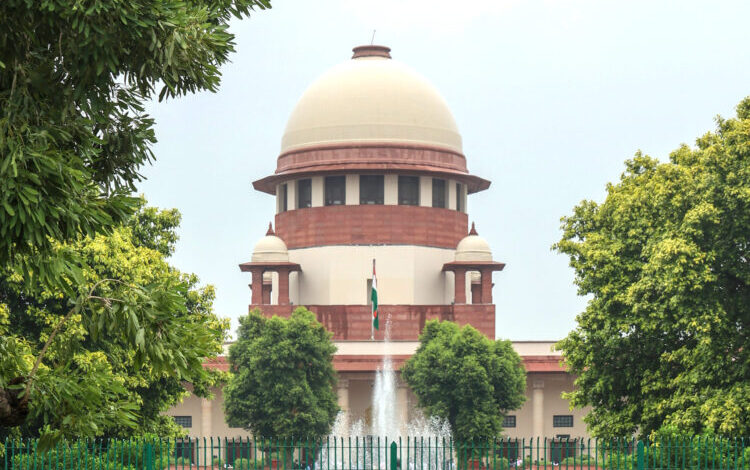
New Delhi: The Supreme Court has held that although there is no absolute bar on filing a fresh bail plea after its cancellation, such relief may be granted only if the accused demonstrates a change in circumstances or raises new grounds that were not considered earlier.
Setting aside an Allahabad High Court order granting bail to an accused in an attempt to murder and Arms Act case, a Bench of Justices Sanjay Karol and N.K. Singh observed that the impugned decision had ignored settled principles governing successive bail applications and failed to consider the accused’s conduct after cancellation of bail by the apex court.
The case arose from an FIR registered at Partapur Police Station in Uttar Pradesh’s Meerut under Sections 147, 148, 149, 323, 324, 452, 504, 506 and 307 of the IPC, along with provisions of the Arms Act.
According to the prosecution, the accused persons allegedly attacked and threatened members of the complainant’s family in an attempt to force a compromise in a separate murder case involving the complainant’s brother.
In its order, the apex court recorded that the accused Zeeshan was allegedly captured in CCTV footage arriving on a motorcycle, retrieving a country-made pistol from his house, and proceeding to the roof of an adjacent building, following which sounds of gunshots were heard. It also took note of the prosecution’s claim that the accused, in his statement before the investigating officer, admitted to firing multiple rounds and concealing the weapon and cartridges, which were later recovered at his instance.
Earlier, the Allahabad High Court had granted bail to the accused in October 2024, but the order was subsequently set aside by the Supreme Court in January 2025 after finding that the High Court had wrongly treated the accused’s role as “vague and general”.
Despite the apex court directing him to surrender forthwith, the accused allegedly evaded arrest for around 42 days, compelling the trial court to issue non-bailable warrants and initiate proceedings under Section 82 CrPC.
After surrendering, the accused filed a second regular bail plea, which was rejected by the trial court in May 2025. However, the Allahabad High Court again granted him bail in September 2025, citing delay in lodging the FIR, absence of firearm injuries and parity with a co-accused.
Disapproving of this approach, the Supreme Court said the impugned order suffered from “manifest error of law”.
“The impugned order does not advert to the reasons that impelled this court to cancel bail, nor does it identify any supervening circumstances or changed factual matrix that might justify a departure from the position adopted by this Court in the earlier round,” the Justice Karol-led Bench observed.
Clarifying the legal position on successive bail pleas, the top court said: “While there is no absolute bar against a High Court granting bail to an accused whose bail was previously cancelled by this Court, the grant of bail must be supported by reasons demonstrating either a change in circumstances or the existence of fresh grounds not considered by this Court at the time of cancellation.”
It further held that the conduct of the accused after cancellation of bail is a crucial factor while considering a fresh plea for liberty.
“In the instant case, the respondent No. 2 (accused), despite being directed to surrender forthwith by this court… failed to comply with the mandate of this court. He absconded, compelling the trial court to issue an NBW,” the judgment said.
Rejecting the accused’s explanation that the delay in surrender was due to the pendency of a review petition, the apex court clarified that filing a review petition does not automatically stay the original order. It also found fault with the Allahabad High Court order for ignoring crucial material on record, including CCTV footage, eyewitness statements, recovery of the weapon and the earlier rejection of bail by the trial court.
“The CCTV evidence, the eyewitness accounts, the recovery of the weapon and cartridge at his instance collectively constitute a prima facie case against the Respondent No. 2, which finds no reference in the impugned order,” the Supreme Court observed.
On the issue of parity with co-accused, the apex court reiterated that parity cannot be applied mechanically when the role attributed to the accused is materially different.
Referring to broader concerns surrounding witness intimidation, the bench observed that the present offence appeared to be a “premeditated attempt to terrorise” witnesses in the earlier murder case and coerce them into compromise.
“There is no doubt that liberty is important, even that of a person charged with crime, but it is important for the courts to recognise the potential threat to the life and liberty of victims/witnesses, if such an accused is released on bail,” the top court said, quoting an earlier ruling.
Holding the Allahabad High Court order suffers from a manifest error of law, the Supreme Court set aside the bail granted to the accused and directed him to surrender before the trial court.
“The Respondent No. 2 is directed to surrender before the trial court forthwith, failing which the trial court shall take necessary steps, including issuance of NBW to secure his custody,” it ordered.
(IANS)