
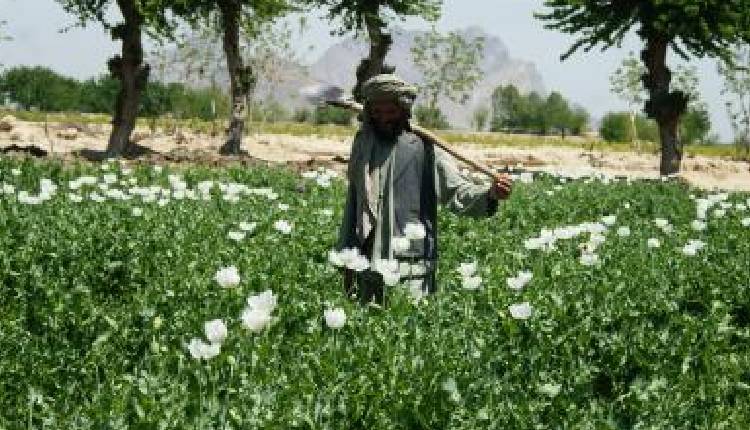
New Delhi: India is in the midst of one of its biggest crackdowns on narcotic smuggling. However, the ISI, which relies on narcotic money to fund terror operations in India has ensured that poppy cultivation in Balochistan has gone up multi-fold so that it can push drugs into the country.
Union Home Minister Amit Shah has repeatedly told the security agencies that he wants to ensure that India is drug free. The ban on poppy cultivation by the Afghan Taliban was a much needed move. Afghan accounted for the highest poppy cultivation in the region prior to its ban on April 3, 2022.
This wiped out 95 per cent of the cultivation of poppy in Afghanistan. India has been a big market for narcotic smugglers. While this ban has been a major relief for India, Pakistan however decided to take advantage of the situation.
It made Balochistan the biggest poppy cultivation hub and also aided the Myanmar cartels in setting up methamphetamine labs.
Indian officials say that this is a crucial period on the war against drugs. The deteriorating situation in Balochistan and Myanmar’s security situation remaining highly volatile and fragile will only lead to narcotic cartels enhancing their trade.
An Intelligence Bureau official said that the ISI, which relies the most on narcotic trade money to fund terror operations in India has ensured that poppy cultivation in Balochistan has gone up multi-fold.
Balochistan has descended into chaos following violent clashes between the Pakistan security forces and the Balochistan Liberation Army (BLA). This chaos has in fact benefited poppy cultivators as they go about their business unabated.
The official added that the ISI will look to take advantage of this situation and aim for a bigger push into the Indian markets.
The situation in Balochistan has even distracted international law enforcement agencies. The focus is more on the violence, which is affecting the minerals deal with the United States and also the China-Pakistan Economic Corridor Project (CPEC), officials say.
Another official said that the violence in Balochistan is no doubt affecting the Pakistan establishment, but the ISI has found ways to benefit from the situation.
The ban on poppy cultivation was in fact a big blow for the ISI. When the Afghan Taliban and Pakistan shared good ties, all the poppy from Afghanistan would go through the Pakistan route.
However, with ties at an all time low and the ban on poppy enforced by the Taliban, Pakistan decided to move the trade into Balochistan.
The ISI invited Afghan poppy farmers into Balochistan to cultivate poppy while also teaching the locals about the process. With the situation in Balochistan failing, officials warn that the ISI would ramp up poppy cultivation and push the produce in much larger bulks into India.
The official said that the Indian law enforcement agencies would need to keep a close watch on four routes.
The Intelligence agencies have learnt that the biggest push would be made through the maritime route. Poppy which is cultivated in Balochistan’s Chagan, Chaghi and Nushki districts is moved into India’s Gujarat and Maharashtra.
Drugs are loaded onto high speed boats before they make their way into India. While the maritime route would be the toughest challenge for the Indian agencies, the ISI has also plans of pushing poppy in much larger numbers using the desert land route from the Balochistan to Rajasthan border.
Officials also warn that the international route could also be used to move drugs into India.
The cartels would move the drugs into Gulf states such as Saudi Arabia, Oman or Dubai before it makes it way into India.
Officials say that the Punjab frontier is already a major cause for concern. Drones are being used to drop in the drugs. The ISI has also helped cartels source drones which have a larger capacity.
The drones are now connected to satellites which have only made its capability to avoid detection even higher, officials say.
Another official said that poppy cultivation in Balochistan is being carried out under the guidance of the ISI. The army, too, is actively assisting these cartels involved in poppy trade.
The official added that the ban on poppy cultivation in Afghanistan had not only benefited India, but other nations in Europe which were also victims of this trade.
However, the ISI and Pakistan army has overcome all of this and has restructured the poppy opium industry in South-West Asia.
Afghanistan used to supply 80 per cent of the world’s opium and 95 per cent of Europe’s heroin. The ISI post the ban stepped in and restructured the entire industry with Balochistan as its main base, officials add.
(IANS)