Dedicated Freight Corridor Cuts Cargo Travel Time, Opens Faster Route For Farmers And Industry: PM Modi

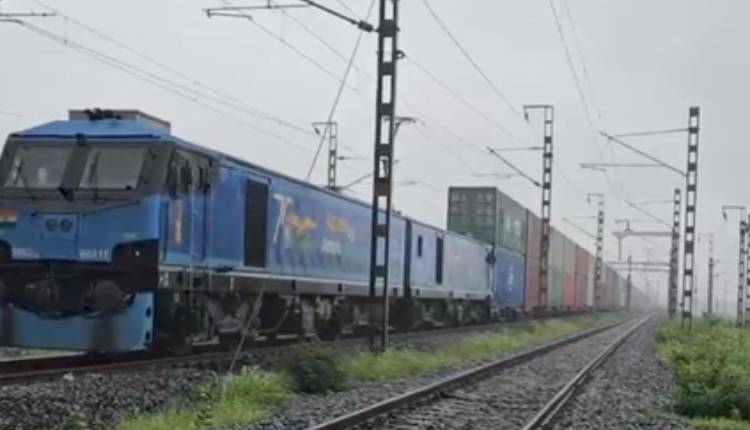
Vadodara: Prime Minister Narendra Modi on Tuesday described the completion of India’s Dedicated Freight Corridor (DFC) network as a major step in transforming the country’s logistics system, saying the infrastructure would cut freight travel time, reduce fuel and transport costs, and help farmers get perishable produce to markets faster.
Addressing a gathering in Vadodara after dedicating the final key sections of the Western Dedicated Freight Corridor (WDFC) to the nation, PM Modi said the completion of more than 2,800 km of dedicated freight infrastructure represented an important achievement for 21st-century India.
The final three WDFC sections cover 326 route kilometres and were developed at a cost of more than Rs 20,700 crore.
Their commissioning makes the DFC network fully operational across its entire length. “Dedicated Freight Corridor is the lifeline of a rapidly developing India,” PM Modi said, describing the project as having transformed the country’s transportation sector.
He said that freight trains had earlier shared tracks with passenger services, resulting in slower movement of both people and goods.
“With dedicated routes now available, freight trains can move independently of passenger traffic. More than 430 freight trains were now running every day on the Eastern and Western freight corridors,” he noted.
He said a freight train that earlier took about six-and-a-half hours to cover 100 km could now cover the same distance in less than half that time on the dedicated corridor.
He also compared road and rail transit times, saying “a journey that could take around 30 hours by truck could be completed in 10 to 12 hours using the freight corridor”.
The gains, he said, extended beyond speed. “Fuel is saved, freight costs have come down, time has been saved, and the environment has benefited,” he asserted, adding that investment in a single railway track is generating multiple benefits.
The corridor is also expected to strengthen links between industrial centres and ports.
The three newly commissioned sections connect Sanand (North)-Makarpura, New Umbergaon-New Saphale, and New Saphale-Jawaharlal Nehru Port Authority (JNPA), providing direct freight connectivity to the major port.
The government has said the infrastructure will facilitate faster EXIM cargo movement, reduce logistics costs and ease congestion on Mumbai’s railway network.
PM Modi also highlighted the implications for agriculture. “Farm produce from eastern and western India could reach larger markets more quickly, particularly commodities such as flowers, vegetables, and fruits that can deteriorate if transportation takes too long,” he said.
He cited the recent operation of a double-stack container freight train between JNPT and Vadodara as an example of the capacity being created. “The train carried a volume of cargo equivalent to more than 250 trucks in a single movement,” he recalled.
The Prime Minister also linked the freight network with wider railway expansion into areas that had remained outside the national rail network for decades, particularly tribal regions of Gujarat, Madhya Pradesh, and Maharashtra.
The programme also saw the launch of freight train services from New Sanand (North), New Makarpura, New Umbergaon and New JNPT, while a new passenger service between Vadodara and Tanda Road was flagged off.
The Jobat-Tanda Road railway line, developed under the Chhota Udepur-Dhar project, was also dedicated to the nation, connecting remote and tribal areas of Alirajpur with the rail network.
PM Modi added that the DFC formed part of a wider expansion of roads, railways, ports, and multimodal infrastructure intended to improve the movement of goods and people.
(IANS)