Anant Nag Receives Dadasaheb Phalke Award; Prez Murmu Hails His ‘Natural, Restrained’ Acting

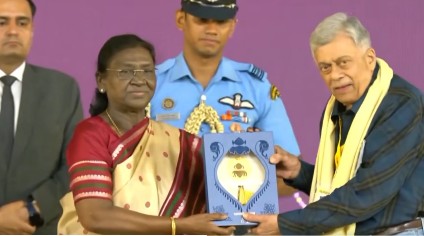
Ekta Nagar (Gujarat): Veteran Kannada actor Anant Nag was conferred the Dadasaheb Phalke Award for 2024 by President Droupadi Murmu at the 72nd National Film Awards ceremony here on Tuesday, with the President praising his five-decade career and describing his acting as a mix of the finest dimensions of theatre and cinema.
Murmu said she was “very pleased” to honour Nag with the highest recognition in Indian cinema and recalled that she had the opportunity to confer the Padma Bhushan on him last year.
“His acting in films presents a synthesis of the finest dimensions of theatre and cinema,” the President said, adding that serious students of cinema consider his acting “natural, restrained and authentic”.
She said Nag’s contribution had established him as an example for artists of future generations.
The Dadasaheb Phalke Award, announced by the Ministry of Information and Broadcasting on September 16, recognised Nag’s “outstanding and invaluable contribution” to the growth and development of Indian cinema and his cinematic journey spanning more than five decades.
Murmu recalled Nag’s early association with theatre, saying he joined the company of prominent theatre personalities at a very young age.
“In his first play, he portrayed Chaitanya Mahaprabhu, and in his second play, he played Gautam Buddha,” she noted.
Nag began his film career in the early 1970s and went on to work extensively in Kannada cinema, besides Hindi and other South Indian-language films.
He has appeared in more than 300 films during a career that has also included significant work in theatre and television.
Veteran actor Anant Nag was honoured with the prestigious Dadasaheb Phalke Award at the 72nd National Film Awards at Ekta Nagar.
The 78-year-old actor, with a cinematic journey spanning over five decades, has appeared in over 300 films in Kannada, Hindi, and other South Indian languages, and also held a significant presence in theatre.
This recognition follows his receipt of the Padma Bhushan the previous year, making him only the second Kannada actor after Dr Rajkumar to be awarded both the Padma Bhushan and Dadasaheb Phalke Award.
Known for his naturalistic acting and portrayal of the ‘ordinary man,’ Nag carved a niche in Indian cinema that distinguished him from the prevailing action and dance-driven narratives.
His versatility earned him the title of ‘evergreen hero.’ He has received numerous accolades, including five Filmfare Awards, five Karnataka State Best Actor Awards, and the Karnataka State Lifetime Achievement Award.
Born in Mumbai on September 4, 1948, and with family roots in Karnataka’s Uttara Kannada district, Nag began his artistic journey in theatre inspired by English plays and notable directors like Satyadev Dubey, Girish Karnad, and Amol Palekar.
He debuted in films in 1973 with a Kannada movie.
The President’s remarks came as the National Film Awards ceremony was held outside New Delhi for the first time in its history, with Ekta Nagar in Gujarat chosen as the venue.
The ceremony was organised near the Statue of Unity, with the President linking the location to India’s cultural and national unity.
Murmu also used the occasion to underline the collective nature of filmmaking, asking award winners to convey her appreciation to all members of their teams whose contributions made their films possible.
“Many people contribute to the making of a film,” she said, asking the winners to ensure that her appreciation reached everyone involved in their productions.
She said films made in different Indian languages and regions reflected India’s diversity, including the dreams, traditions, struggles and future possibilities of its people.
Nag’s recognition was among the central honours at the ceremony, which also saw Mammootty and Kartik Aaryan jointly receive the Best Actor award, Yami Gautam win Best Actress and Randeep Hooda receive the Best Debut Film of a Director award.
The 72nd National Film Awards cover films certified during 2024 and recognise achievements across feature films, non-feature films and writing on cinema. The awards were instituted in 1954.
(IANS)