
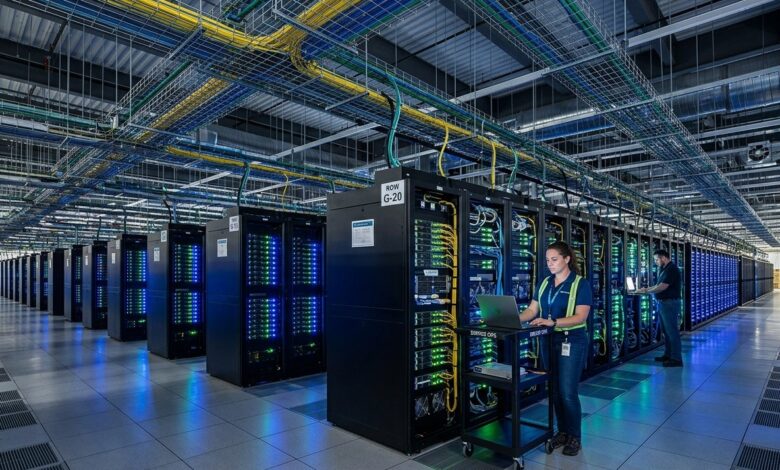
New Delhi: Artificial intelligence-led demand is emerging as a defining force in India’s data centre sector, with cumulative colocation leasing reaching 2.06 GW in 2025, a report said on Tuesday.
As per analysis by Knight Frank India, nearly 20 per cent of total leasing demand is now directly linked to AI-related workloads, as generative AI, machine learning applications and GPU-intensive computing reshape infrastructure requirements across industries.
AI-related colocation leasing alone reached 348 MW in 2025, more than doubling compared with 2024, reflecting a sharp acceleration in demand following the global AI boom and increased enterprise adoption of high-performance computing, according to the report.
In addition, India’s data centre market continues to witness strong structural expansion, supported by hyperscale cloud growth, enterprise digitisation, regulatory-led data localisation and increasing demand for low-latency digital infrastructure.
The sector has transitioned from a fragmented infrastructure base into a strategic institutional asset class over the past decade, with sustained capital inflows and a rapidly expanding development pipeline, the report said.
However, despite rapid capacity additions, vacancy levels across key markets remain tight, indicating continued strong absorption from hyperscalers and large enterprise occupiers.
India’s live data centre capacity has expanded significantly, rising from around 296 MW in 2016 to over 1.6 GW in 2025, recording a multi-year compound annual growth rate of nearly 30 per cent.
The report highlighted that committed and early-stage development pipelines have now crossed 8 GW across major markets, underscoring strong long-term visibility for supply growth.
City-wise, Mumbai accounts for nearly 47 per cent of India’s total live capacity, supported by strong fibre connectivity, submarine cable landing stations and its role as the country’s financial hub, while Chennai has strengthened its position as a key gateway for Southeast Asia data traffic.
Meanwhile, Hyderabad is emerging as a major AI and hyperscale infrastructure hub supported by state policy incentives and growing cloud investments.
Bengaluru, Pune and the Delhi-NCR (National Capital Region) are evolving as specialised markets driven by enterprise demand, GCC expansion and BFSI workloads, while Tier-II cities are increasingly attracting new investment announcements.
(IANS)