
EAM Jaishankar Calls To Move Beyond ‘Uni-Dimensional’ Science Narrative, Urges Recognition Of India’s Contributions

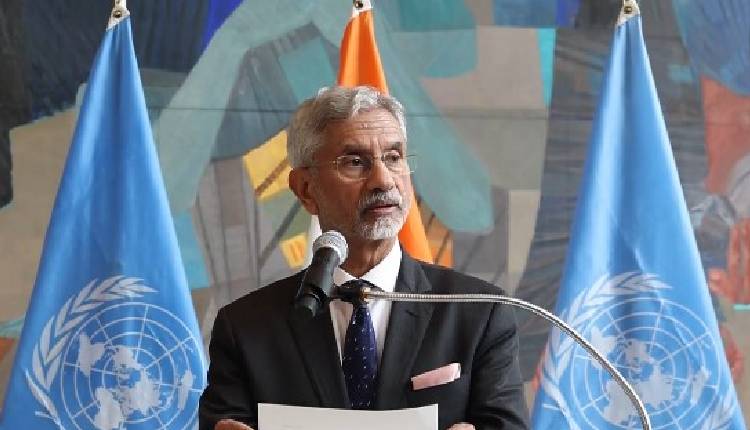
United Nations: External Affairs Minister S Jaishankar has called for moving away from the “uni-dimensional narrative” about mathematics and the sciences to one based on a “democratisation of history” that recognises India’s foundational contributions.
Inaugurating an exhibition on India’s contribution to mathematics here on Monday, he cited the example of the binary system developed in India in the third century, on the foundation of which rest the digital age and the world’s journey into AI.
“These truths will increasingly become apparent as we embark on the journey of AI, where our grasp of the past will profit from the tools of the future”, he said.
“This exhibition is a reminder that mathematics is a universal language, and its spread has served and continues to serve a global good”, he said.
The AI Impact Summit in India in February “sent a strong message that creativity and innovation cannot be limited to a few”, he added.
“It is only by righting the distortions of the past that we can accurately address issues of the future”, he said.
This matters to the UN, he said, “because a diverse and democratic collective cannot be built on a unidimensional narrative”.
“We need to appreciate that democratisation of technology, indeed, democratisation of the world, requires a democratisation of history”, he added.
“Scientific progress has, for far too long, been viewed through a narrow lens, limited in time and in geography”, he said.
But “as geopolitical churn ushers in a political and economic rebalancing, it is inevitably paving the way for a cultural rebalancing too, and that will be done by making space for diverse narratives”, he said.
The interactive exhibition, “Global Diffusion of Mathematics”, was created under the India International Centre’s SAMHITA programme to project “India’s learned inheritance (that) spans fields including medicine, mathematics, architecture, philosophy, aesthetics and literature”.
A series of digital panels shows India’s ancient mathematical prowess, from the basic binary numerical system to algebra and calculus.
On display were the mathematical landmarks which Jaishankar referred to: The binary system that has its roots in Pingala’s third century Chanda Sutra; the rhythm of ancient verses that was actually algorithmic; the infinite series for Pi, and the principles of what is now called the Pythagorean theorem”.
The exhibition, located prominently at the delegates’ entrance, the gateway for the top envoys of the 193 UN members, Jaishankar said, “will also help cast aside prejudices and assumptions about the embrace of technology in the current era”.
India’s Permanent Representative P Harish said, “The exhibition traces our foundational concepts such as zero, the decimal system, algebra, trigonometry, and early notions of infinity (that) travel from India across cultures, through centres of learning like Baghdad and Toledo into the wider world.”
“India always made available its knowledge to the entire world — open source in today’s language, was an Indian mantra since time immemorial”, he said.
(IANS)