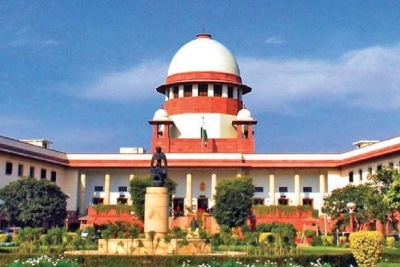


New Delhi: The Mamata Banerjee-led faction of Trinamool Congress (TMC) has moved the Supreme Court challenging the delay by Lok Sabha Speaker Om Birla in deciding the disqualification petitions filed against 20 rebel party MPs, with the plea slated to be heard on Tuesday by a Bench headed by Chief Justice of India (CJI) Surya Kant.
The writ petition has been filed through TMC national general secretary and the party’s Diamond Harbour Lok Sabha member Abhishek Banerjee, who has challenged the inaction on the disqualification proceedings initiated against the 20 MPs under the anti-defection law.
As per details available on the website of the apex court, the matter has been registered as W.P.(C) No. 1033/2026 and is listed for hearing on August 25 before a Bench of CJI Kant and Justices Joymalya Bagchi and V. Mohana.
The respondents include the Speaker of the Lok Sabha, Secretary General of the Lok Sabha and the 20 rebel MPs, including Kakoli Ghosh Dastidar, Sudip Bandyopadhyay, Satabdi Roy, Prasun Banerjee, Rachana Banerjee, Jagadish Chandra Barma Basunia, Partha Bhowmick, Arup Chakraborty, Adhikari Deepak Dev, Sayani Ghosh, Bapi Haldar, Md Abu Taher Khan, Kalipada Saren Kherwal, Asit Kumar Mal, June Maliah, Mitali Bag, Khalilur Rahaman, Mala Roy, Sharmila Sarkar and Pathan Yusuf.
The petition challenges the delay in taking a decision on the disqualification proceedings against the rebel MPs.
The TMC has maintained that the MPs were elected on the party’s symbol and that their subsequent decision to join another political formation attracts the provisions of the anti-defection law.
Abhishek Banerjee had earlier submitted separate disqualification petitions before Speaker Om Birla and repeatedly sought their expeditious disposal.
The issue has been at the centre of an escalating political battle within the TMC’s parliamentary unit after the 20 MPs broke away from the party and joined the Nationalist Citizens Party of India (NCPI), claiming recognition as a separate parliamentary group.
The rebel faction had earlier claimed the support of more than two-thirds of TMC’s Lok Sabha MPs and sought recognition as a separate group.
Jagadish Chandra Barma Basunia, one of the rebel MPs, had said that the group wanted to stake a claim as the “real Trinamool Congress” and seek separate recognition in the Lok Sabha.
The TMC, however, has argued that merely having two-thirds of the legislators does not by itself satisfy the requirements of the merger provision under Paragraph 4 of the Tenth Schedule. It has maintained that MPs voluntarily giving up the party’s membership and joining another political formation attracts disqualification.
The dispute intensified after separate seating arrangements were allotted to the 20 rebel MPs in the Lok Sabha, even as the Speaker had not formally taken a decision on the disqualification petitions.
In July, West Bengal Chief Minister Suvendu Adhikari had also travelled to New Delhi to meet the rebel MPs, who had aligned themselves with the NCPI and claimed to be supporting the ruling NDA at the Centre.
The political developments had added to the uncertainty surrounding the pending disqualification proceedings.
Earlier, TMC leaders, including Abhishek Banerjee, Mahua Moitra and Kalyan Banerjee, had met the Lok Sabha Speaker and sought immediate action on the disqualification petitions.
On July 27, Abhishek Banerjee again wrote to Speaker Om Birla urging expeditious disposal of the petitions against the 20 MPs.
The outcome of the disqualification proceedings is expected to have significant political implications for both the rebel MPs and the TMC.
The Supreme Court is also separately seized of the larger constitutional question concerning the interpretation of the anti-defection law.
Senior advocate Kapil Sibal has moved the Supreme Court as a party-in-person through a writ petition challenging the interpretation of Paragraph 4 of the Tenth Schedule, which deals with mergers of political parties.
Sibal has contended that the existing legal position enables splinter groups of legislators to escape disqualification by taking the route of mergers with other political parties, thereby diluting the purpose of the anti-defection law.
(IANS)