BRICS Summit Put India Firmly On Global Diplomatic Stage, Demonstrated New Delhi’s Convening Power: Experts

New Delhi: India’s BRICS presidency demonstrated its ability to bring diverse members together and forge consensus on several important issues, top analysts reckoned on Wednesday while spotlighting the huge success of 18th BRICS Summit where New Delhi not only successfully convened the expanded grouping but also managed to secure consensus on the Delhi Declaration despite current challenging geopolitical and geoeconomic environment.
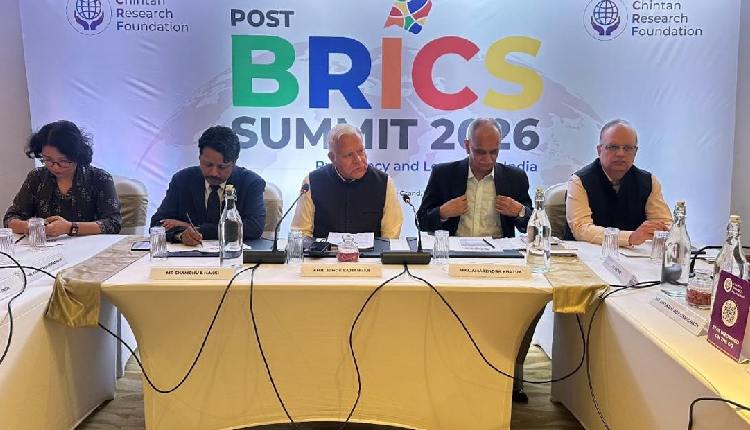
Distinguished diplomats and eminent representatives from policy circles, academia, think tanks and the wider strategic community, who gathered in the capital for a significant roundtable discussion convened by the Chintan Research Foundation (CRF), asserted that the summit has put India firmly on the global diplomatic stage.
Titled ‘Post BRICS Summit 2026: Presidency and Lessons for India’ and held three days after the conclusion of the BRICS Summit in New Delhi under India’s chairmanship, the roundtable outlined that a significant outcome for India was the consensus on the 2025 Pahalgam attack, alongside a call for zero tolerance for terrorism and disruption of terror financing. Discussions also focused on making BRICS expansion more representative and steering the grouping away from an explicitly anti-West orientation towards a more centrist position.
Speakers and participants observed that under India’s chairmanship, BRICS had broadened its agenda beyond its traditional focus on geopolitics and de-dollarisation. Its agenda now encompasses trade resilience, institutional reform, security, health, food and energy security, climate, technology, entrepreneurship, people-to-people connect, women’s empowerment, critical minerals, artificial intelligence and education. This reflected efforts to position BRICS as a comprehensive platform for Global South cooperation rather than a narrowly geopolitical bloc.
Delivering the keynote address, Shambhu L Hakki, Joint Secretary (Multilateral Economic Relations and G20) in the Ministry of External Affairs (MEA) and India’s G20 and BRICS Sous-Sherpa, explained the success of India’s presidency in successfully pulling off the summit given the current challenges the Global South and the world is facing.
He highlighted that the Delhi Declaration that was adopted during the summit signalled practical cooperation between developing countries. The presence of the African Union, ASEAN, CELAC, GCC and BIMSTEC provided a wide range of cooperation as well as more representation of developing countries. The grouping coordinated on global economic issues, institutional reforms and building a unified network for the Global South.
The heads of National Standardization Bodies (NSBs) during the summit came together and discussed harmonising standards and reducing trade barriers. The importance of the Troika Agreement was highlighted to ensure institutional continuity across annual presidency rotations. Prime Minister Narendra Modi challenged the 11-member bloc to collaborate on 10 global governance reform proposals over the upcoming months to form a unified BRICS Reform Roadmap, ahead of the next summit in China.
The discussion reviewed the major outcomes of the summit and their strategic relevance, examined emerging areas of convergence and divergence among BRICS members, and assessed the implications of the grouping’s expansion.
Seasoned diplomat Ambassador Ashok Sajjanhar focused on the litmus test for India to come out with a consensus given the challenges the member countries were facing. The Delhi Declaration was more about practical cooperation and shared that all the points of consensus that were reached should be implemented and not just remain on paper. India tried to shape a collaborative forum and not a confrontational one. He brought out the point of the G7 under France’s presidency showing interest in collaborating with BRICS because the G7 countries, maybe except for one, understand that the action on connectivity, global supply chains and finance, etc., lies in the Global South.
The discussion also highlighted the significance of the participation of leaders including the Presidents of Russia, China and Iran, as well as the bilateral meeting between the Iranian President and the UAE’s high-level representative. Participants discussed changing perceptions of the United States, including the view expressed during the roundtable that it had moved from being seen as a liberator to becoming a disruptor and a “rent-seeking landlord” in South Asia.
The summit also deliberated on the challenges surrounding de-dollarisation, the absence of a common BRICS currency, and the importance of strengthening cross-border payment mechanisms and the New Development Bank (NDB). China proposed the establishment of a BRICS open-source artificial intelligence (AI) community, although members expressed scepticism over the proposal. The summit reiterated the “humanity-first” approach and emphasis on practical cooperation that defined the vision of India’s presidency. As with any multilateral process, however, many of its outcomes are inherently long-term and may take time to materialise rather than yielding immediate results, the analysts reckoned.
BRICS expansion featured prominently in the deliberations during the roundtable. Participants underlined the need to pay greater attention to interest from South Asian countries and the potential contribution they could make to the grouping. Pakistan’s possible inclusion was discussed in terms of the complications it could create for BRICS, while Malaysia was mentioned in the context of the additional weight it could bring to the grouping. Participants also called for sustained economic engagement with partner countries such as Cuba and Bolivia.
The roundtable concluded with recommendations for the early implementation of cross-border payment mechanisms, the BRICS grain exchange and remote-sensing satellite constellations, alongside further strengthening of the New Development Bank. Wealth creation from waste was also highlighted as an area in which BRICS could develop practical cooperation.
The experts underscored that the significance of India’s BRICS presidency lay not merely in successfully convening an increasingly diverse grouping, but in its ability to generate consensus around practical cooperation while seeking to position BRICS as a more representative and constructive platform for the Global South.
(IANS)