Dr Mookerjee Left Enduring Imprint On India’s Educational, Political, Democratic Journey: VP Radhakrishnan

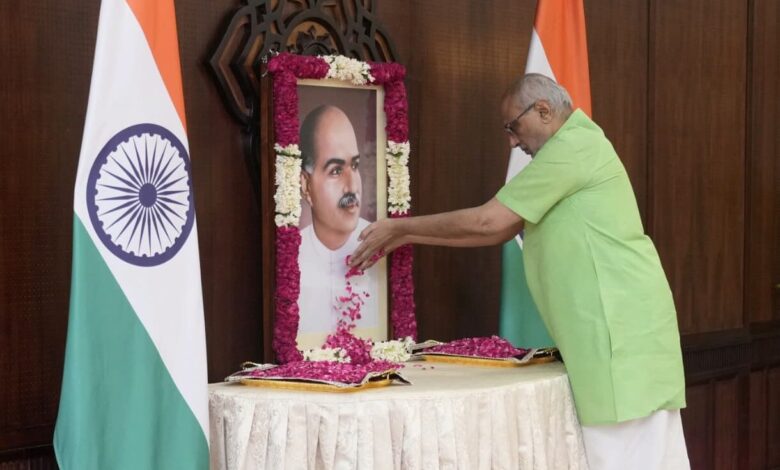
New Delhi: Vice President, C.P. Radhakrishnan on Monday paid floral tributes to Dr. Syama Prasad Mookerjee at the Uprashtrapati Bhawan on the late leader’s 125th birth anniversary and said that he left an enduring imprint on India’s educational, political and democratic journey.
VP Radhakrishnan took to social media ‘X’ and said, “Paid floral tributes to Dr. Syama Prasad Mookerjee at the Uprashtrapati Bhawan today on his 125th birth anniversary.”
“A distinguished educationist, visionary statesman and nation-builder, Dr. Mookerjee left an enduring imprint on India’s educational, political and democratic journey. As one of the youngest Vice-Chancellors of the University of Calcutta, a member of the Constituent Assembly, President of the Akhil Bharatiya Hindu Mahasabha, Independent India’s first Minister for Industry and Supply, and founder of the Bharatiya Jana Sangh, he rendered exceptional service to the nation,” he said.
“A steadfast champion of national unity and integrity, he made the supreme sacrifice in Jammu & Kashmir while striving for its full integration with Bharat. His life and ideals continue to inspire generations in the collective endeavour to build a strong, united, self-reliant and developed India,” he added.
Radhakrishnan further said that Dr Mookerjee sacrificed his life for the unity of this nation… such great sacrifices will never go unheeded.
He said that Dr. Mookerjee envisioned an India where every citizen would be equal under a single constitutional framework, and that the abrogation of Article 370 was a tribute to his lifelong commitment to national integration.
Dr Mookerjee was born on July 6, 1901, in Kolkata. He was a prominent Indian politician, barrister and academician and served as the minister for Industry and Supply in the Pandit Jawaharlal Nehru Cabinet.
Dr Mookerjee strongly opposed Article 370 that gave autonomous status to Jammu and Kashmir. He saw it as a threat to national unity. He visited Kashmir in 1953 illegally, and went on a hunger strike to protest the law that prohibited Indian citizens from settling within the state and directing that they carry ID cards. Owing to his efforts, the ID card rule was revoked but he died there on June 23, 1953 under mysterious circumstances.
(IANS)