Former Maha Minister Padamsinh Patil Among Eight Acquitted In Nimbalkar Murder Case

Mumbai: Bringing the curtains down on one of Maharashtra’s longest-running and most politically sensitive criminal cases, a special CBI court in Mumbai on Saturday acquitted all eight accused in the 2006 murder of senior Congress leader Pawanraje Nimbalkar and his driver Samad Abdul Wahid Kazi, citing lack of evidence.
Among those acquitted was former Maharashtra Home Minister and ex-NCP MP Padamsinh Patil, 86, who was alleged by the CBI to be the key conspirator behind the killings.
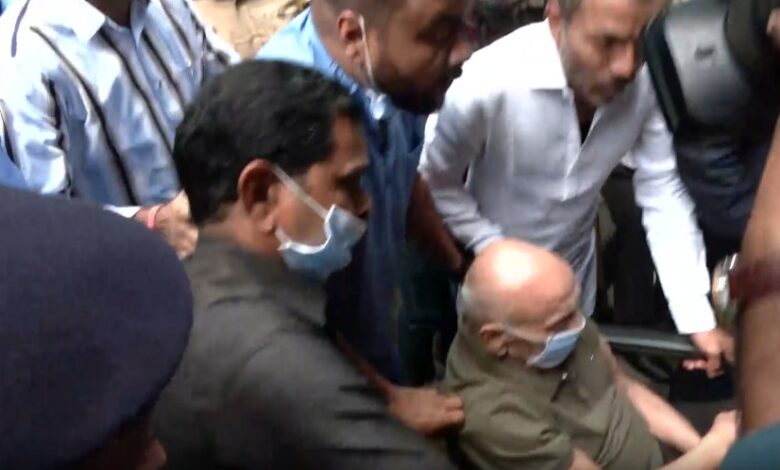
Patil, who is also Nimbalkar’s first cousin, arrived at the court in a wheelchair, accompanied by a hospital attendant.
The verdict marks the culmination of a legal battle that spanned nearly two decades and drew widespread attention because of the political stature of those involved, the family rivalry at its core, and allegations of a contract killing linked to cooperative-sector politics in the Dharashiv (formerly Osmanabad) region.
Pawanraje Nimbalkar and his driver were gunned down on June 3, 2006, when their vehicle was intercepted by assailants in Navi Mumbai. The attackers allegedly stopped the car on the pretext of making an inquiry before opening indiscriminate fire, killing both on the spot.
At the time of his death, Nimbalkar was a prominent Congress leader and a sitting MLA who had held several important positions in Maharashtra politics. The CBI subsequently described the murder as a pre-planned contract killing and alleged that it was executed as part of a larger criminal conspiracy.
The investigation was initially carried out by Navi Mumbai Police. However, amid allegations that the probe was being suppressed, Nimbalkar’s widow, Anandibai Nimbalkar, approached the Bombay High Court, which later transferred the case to the CBI.
According to the agency, the murder was rooted in an intense political and personal rivalry between Nimbalkar and Padamsinh Patil. The two leaders, despite being first cousins, had emerged as bitter political adversaries. Their feud intensified during the 2004 Maharashtra Assembly elections, when Nimbalkar contested against Patil and lost by a narrow margin of just 484 votes.
The rivalry also extended to the cooperative sector, particularly the influential Terna Sugar Cooperative Factory, where both leaders vied for control and influence.
The CBI further alleged that Nimbalkar had exposed financial irregularities linked to Patil and had supplied information to anti-corruption activist Anna Hazare. Investigators even claimed that Hazare figured on a list of potential targets allegedly prepared by the conspirators.
The prosecution’s case largely rested on the testimony of an accused-turned-approver, Parasmal Jain, who claimed to have detailed the manner in which the conspiracy was hatched. The agency alleged that a contract amounting to Rs 25-35 lakh had been paid to eliminate Nimbalkar.
Padamsinh Patil was arrested by the CBI in June 2009 and later granted bail by the Alibaug Sessions Court in September that year. Despite the sensational allegations and prolonged proceedings, the court ultimately held that the prosecution had failed to prove its case beyond a reasonable doubt and acquitted all the accused.
Present in court when the judgment was pronounced was Nimbalkar’s son, Omprakash Raje Nimbalkar, currently a rebel Lok Sabha MP associated with the Uddhav Thackeray-led Shiv Sena faction.
The acquittal of all eight accused brings an end to a case that for nearly 20 years symbolised the intersection of political rivalry, family discord, and criminal justice in Maharashtra.
(IANS)