Maharashtra Ready To Lead In Nuclear Energy, CM Fadnavis Invites US Investors

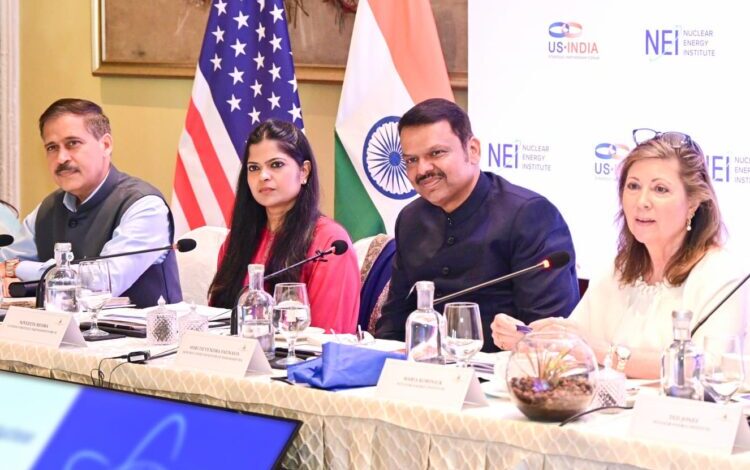
Mumbai: Chief Minister Devendra Fadnavis on Wednesday said that Maharashtra is ready to lead the transition in the nuclear energy sector and appealed to American companies to invest in the state.
He further stated that Artificial Intelligence (AI), data centres, semiconductors, green hydrogen, electric mobility, and advanced manufacturing are driving a massive surge in the demand for stable and uninterrupted power.
Long-term industrial growth cannot rely solely on solar and wind energy; nuclear power will be critical for the future industrial economy.
The Chief Minister was speaking at a meeting hosted by the Nuclear Energy Institute (NEI) and the US-India Strategic Partnership Forum (USISPF) under the US Nuclear Executive Mission in India.
The CM’s statement comes a day after the state government signed MoUs for the development of nuclear power projects with total generation capacity of 25,400 MW.
CM Fadnavis noted that profound shifts are occurring globally in energy transition. For years, the consensus was that renewable sources like solar and wind would solve future energy crises. However, rapid industrialisation and the digital economy now demand stable, baseload power.
While Maharashtra continues to invest heavily in solar and wind, nuclear energy is essential for a carbon-free, industrial-scale power supply, he said.
“Maharashtra is the country’s leading industrial state with a $660 billion economy, attracting over 40 per cent of India’s total Foreign Direct Investment (FDI). Nearly 60 per cent of India’s data centre capacity is concentrated in the Mumbai and Navi Mumbai regions.
“In the coming days, demand for electricity will multiply due to advancements in semiconductors, AI, logistics, and advanced manufacturing,” CM Fadnavis said.
He added that US-India civil nuclear cooperation has seen positive shifts recently.
Private sector participation, reforms under the ‘SHANTI’ framework, technology transfer, and industrial cooperation have unlocked new avenues of growth. With India’s power demand projected to skyrocket over the coming decades, Maharashtra will remain its primary industrial engine.
The Chief Minister emphasised that Maharashtra aims to sit at the centre of India’s nuclear journey. The state does not wish to be a mere consumer of imported nuclear reactors, but intends to develop into a hub for nuclear manufacturing, technology partnerships, and global exports.
To support this, Maharashtra offers a robust industrial ecosystem, world-class ports, logistics infrastructure, highly skilled technical manpower, engineering capabilities, and pro-industry policies.
CM Fadnavis assured American companies that if they take the initiative to set up nuclear manufacturing and projects, the state government will provide extensive support.
This includes industrial land, infrastructure, skill development, research collaboration, and the establishment of manufacturing clusters.
He also expressed readiness to offer subsidies and special incentives for early-stage ventures.
Furthermore, Maharashtra is eager to become an early hub for Small Modular Reactors (SMRs), viewing SMR technology as an ideal match for next-generation nuclear energy needs.
“Civil nuclear cooperation could be the next defining frontier in the US-India partnership, which is already strengthening across technology, defense, AI, and supply chains. Nuclear energy is not just about power generation; it is tied to industrial competitiveness, technological leadership, energy sovereignty, climate responsibility, and long-term trust,” the Chief Minister explained.
Echoing this optimism, Nuclear Energy Institute (NEI) President, Maria Korsnick, acknowledged the massive opportunities in India’s nuclear sector. She remarked that Maharashtra’s skilled workforce, industrial technology, and existing supply chains make it a highly lucrative investment destination.
During the session, Additional Chief Secretary (Energy), Abha Shukla, delivered a presentation detailing the state’s escalating energy demands.
“Maharashtra’s current power demand stands at 31 GW and is projected to reach 42 GW by 2030. The state has set an ambitious target to meet 65 per cent of its energy requirements from renewable sources by 2035,” she said.
Recognising the limits of weather-dependent renewables for heavy industry, the state has begun extensive preparations to integrate nuclear power as its next major energy pillar, said Shukla.
Mahagenco CEO Radhakrishnan B. outlined the state utility’s ongoing projects. He revealed that Mahagenco has set a target to generate 7,000 MW of nuclear energy over the next two decades. As India’s largest state-owned power generation company with a current capacity of 14.5 GW, Mahagenco is actively shifting its focus away from coal-based generation toward nuclear energy.
The utility is exploring SMR technology to cater directly to the high-density requirements of industrial clusters, including steel, cement, fertiliser industries, and data centres.
(IANS)