NCB Hosts India-US Counter-Narcotics Working Group Meeting To Boost Anti-Drug Cooperation

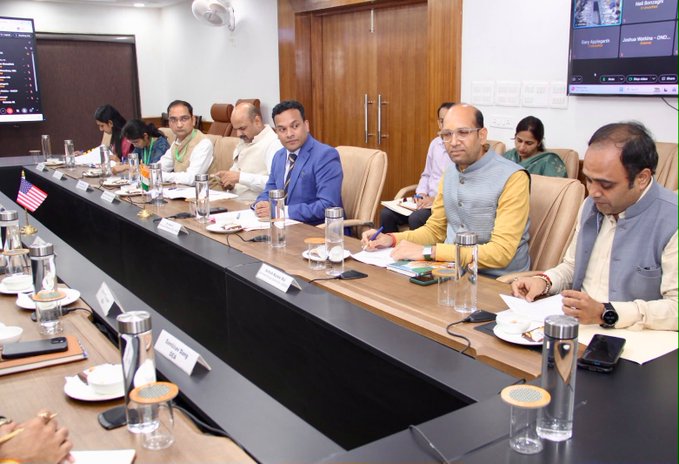
New Delhi: The India-US Counter Narcotics Working Group (CNWG) Pillar I Working Group Meeting was hosted by the Narcotics Control Bureau (NCB) in a hybrid format, aimed at strengthening bilateral cooperation in combating narcotics trafficking and the diversion of precursor chemicals.
The NCB shared details of the meeting on the social media platform X, stating, “The India-US Counter Narcotics Working Group (CNWG) – Pillar I Working Group Meeting was hosted by the Narcotics Control Bureau on 6 August 2026 in hybrid mode.”
The meeting brought together representatives from several Indian and US agencies. Participants from the Indian side included the NCB, Central Bureau of Narcotics (CBN), Directorate of Revenue Intelligence (DRI), Central Drugs Standard Control Organisation (CDSCO), Ministry of External Affairs (MEA), Department of Revenue, and Department of Chemicals and Petrochemicals.
The US delegation included officials from the Drug Enforcement Administration (DEA), LEGAT, Office of National Drug Control Policy (ONDCP), and the US Department of State.
According to the NCB, the discussions focused on strengthening operational cooperation, preventing the diversion of precursor chemicals, enhancing policy coordination, and advancing capacity building.
India highlighted its robust precursor control framework and ongoing initiatives to further strengthen regulatory and enforcement mechanisms to prevent the diversion of precursor chemicals.
The meeting follows earlier discussions held in March during the 69th Session of the United Nations Commission on Narcotic Drugs in Vienna, Austria. During those talks, NCB Director General Anurag Garg and Sara Carter, Director of the US Office of National Drug Control Policy, discussed sharing actionable intelligence to bolster counter-narcotics cooperation. Both sides also explored mechanisms for real-time information sharing to facilitate parallel investigations against transnational drug cartels operating across jurisdictions.
Meanwhile, the Central government informed the Lok Sabha this week that the NCB has strengthened international cooperation in drug control through bilateral agreements with 27 countries and Memoranda of Understanding (MoUs) with 19 countries.
Minister of State (MoS) for Home Affairs Nityanand Rai, in reply to a query, had said that India holds regular Director General (DG) Level/bilateral talks on drug-related matters with countries such as Myanmar, Nepal, Thailand, Sri Lanka, Indonesia, Singapore and the US.
Responding to questions by Naresh Ganpat Mhaske and Shrikant Shinde, Rai added that to address the challenge of illicit drug trafficking and abuse of drugs, Vision Document on Narcotics Control (2026-2029) was released on June 26, which lays down a three-year roadmap with clear priorities and time bound targets to be achieved by various stakeholders to control drugs with ‘Whole-of-Government’ and ‘Whole-of-Society’ approach.
The MoS said the NCB has also established a four-tier Narco-Coordination Center (NCORD) mechanism for ensuring better coordination between Central and state drug law enforcement agencies and other stakeholders in the field of controlling drug trafficking and drug abuse in India.
(IANS)