Sharad Pawar Urges CM Fadnavis To Declare Drought In Maharashtra, Seeks Relief Package For Farmers

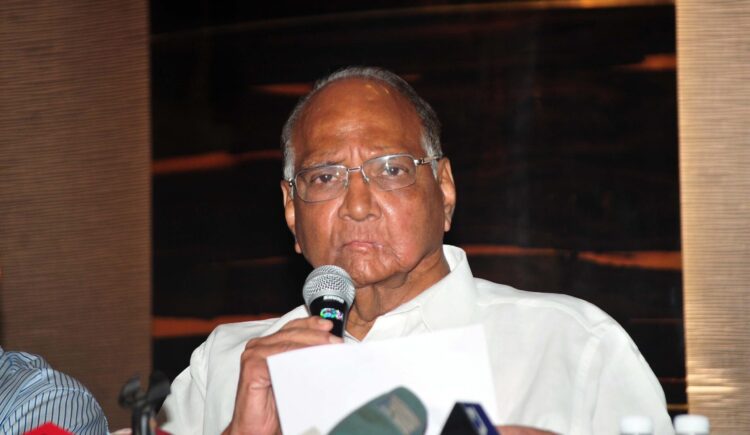
Mumbai: Nationalist Congress Party-SP (NCP-SP) chief Sharad Pawar has raised the severe agrarian crisis in Maharashtra due to erratic monsoon rains with Chief Minister Devendra Fadnavis and demanded immediate intervention on nine key points.
His letter to the Chief Minister comes shortly after Fadnavis expressed his resolve to make Marathwada drought-free on the occasion of Marathwada Liberation Day.
Citing the stark ground reality, Pawar, who uploaded the letter on Friday on X, emphasised that deficient rainfall has severely impacted crops across Marathwada and other parts of the state, leaving farmers in deep distress, and raised urgent concerns regarding standing crops, drinking water shortages, and fodder scarcity for livestock.
“Due to the failure of rains across most parts of the state this year, the farming community is facing a massive crisis. Standing crops such as soybean, cotton, pearl millet (bajra), maize, pigeon pea (tur), green gram (moong), and black gram (urad) have withered away, compounded by an increase in pest infestations. Consequently, the situation regarding agriculture, drinking water, and fodder supply is set to worsen,” he warned.
The former Union Minister has demanded immediate declaration of drought bypassing formal procedural norms, identifying worst-hit talukas as drought-affected and implementing relief measures without delay, providing financial aid of at least Rs 50,000 per hectare to affected farmers and a special assistance package of Rs 25,000 to landless farm-labour households and implementing a farm loan waiver immediately to ensure fresh crop credit.
He has also emphasised the need to increase the incentive subsidy for farmers who pay loans regularly from Rs 50,000 to Rs 1,00,000, and extend loan waiver benefits to farmers whose crop loans from 2025–26 have defaulted due to current conditions, and implement the Re 1 crop insurance scheme retroactively to ensure coverage for affected farmers. Additionally, he sought release of the previously announced crop insurance compensation of Rs 17,000 per hectare for damage caused by unseasonal rains last year.
Pawar has also demanded the launch of dedicated initiatives under the rural employment guarantee scheme (MGNREGS) for water conservation and agricultural works in affected talukas, supplying water tankers to safeguard fruit orchards, conducting rapid surveys in water-scarce villages to deploy government tankers, establishing fodder camps for livestock based on local demand and starting a special campaign via the Energy Department to repair faulty power transformers on time to counter load-shedding issues during the drought.
Further, Pawar has urged the state government to set up state-level and district-level control rooms to monitor daily rainfall, crop conditions, water scarcity, fodder availability, and livestock health and grant a complete educational fee waiver — rather than just an examination fee exemption — for students studying in schools, colleges, and educational institutes across drought-affected talukas.
“Considering the gravity of this serious situation arising for farmers, farm labourers, livestock, and rural life, it is expected that the Chief Minister will take positive decisions on the above demands and implement necessary remedial measures immediately,” said Pawar in his post on X.
CM Fadnavis has not yet issued an official response to the demands.
Pawar’s communication to the CM comes after the state cabinet on Tuesday reviewed the monsoon situation. The Revenue and Agriculture Departments have informed that 83 talukas across 19 districts have gone without rain for over 20 days. CM Fadnavis and several ministers expressed deep concern over the situation.
Although no immediate relief package was announced, CM Fadnavis instructed state administrative machinery to stay on high alert. Following the Cabinet discussion, the government clarified that a formal drought declaration cannot be made immediately.
Under the National Disaster Response Fund (NDRF) guidelines and Central Drought Management norms, official crop-damage surveys (Panchnamas) and ground verification must be conducted after October 5 to qualify for financial relief. Premature surveys would risk disqualifying farmers from central aid packages. Conducting assessments prior to that date would disqualify the affected farmers from official relief aid and result in an inaccurate estimation of damage. The government is currently preparing a comprehensive list of relief measures for farmers, and officials have been urged to coordinate effectively, said the Agriculture Department in its presentation.
(IANS)